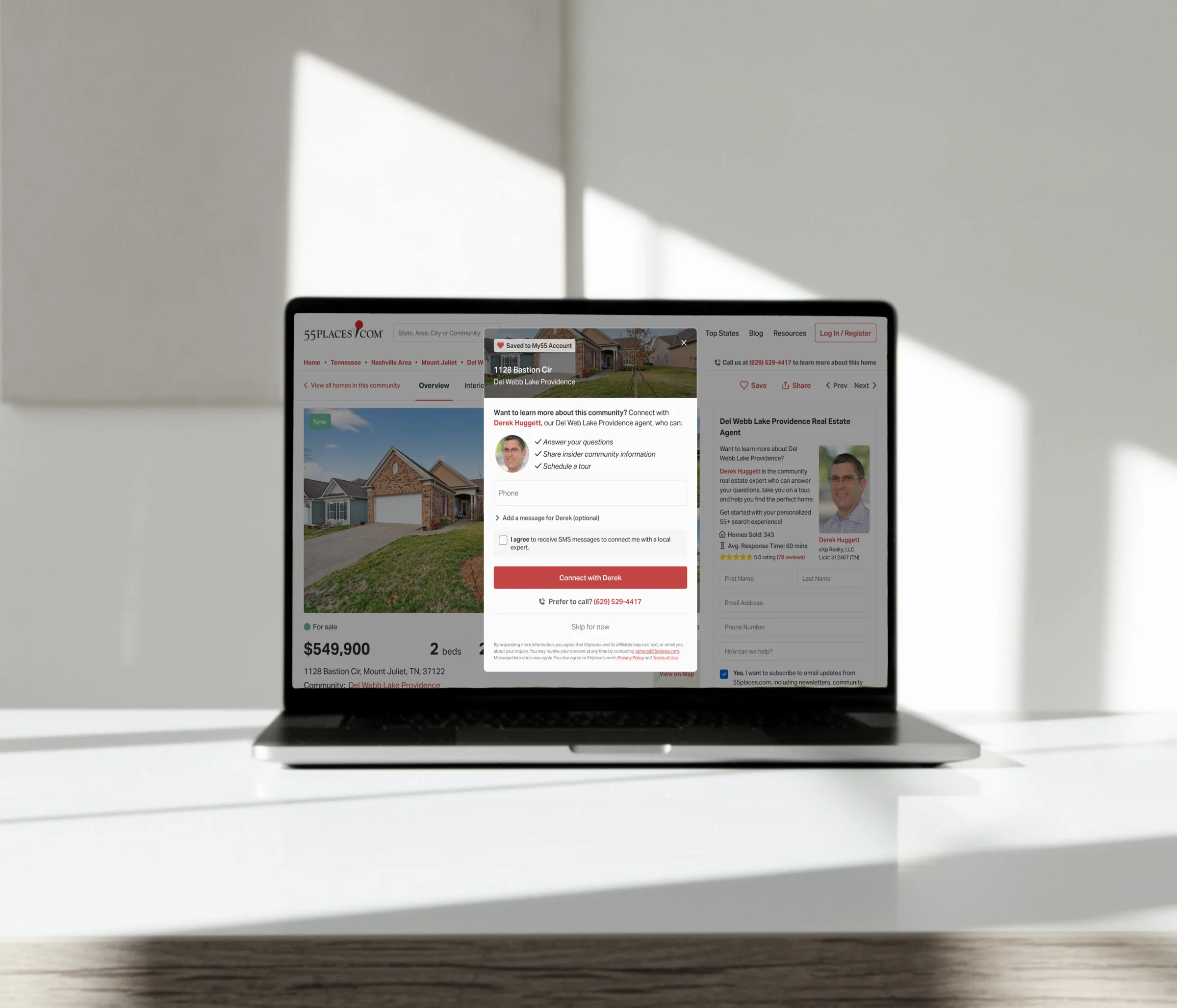
Turning Saves Into Leads
Designing a natural path from exploration to conversion without disrupting discovery
55places · 2026
Summary
55places is a national marketplace where people research and shortlist 55+ communities, homes, and floor plans. Saving one of those is among the strongest intent signals on the site — but the experience treated a save as a plain account-registration event and stopped there, leaving motivated users without a contextual way to reach an agent. I redesigned the post-save journey into a two-step progressive flow: confirm the save, then offer an opt-in connection to a local expert using data the account already collected. The tested variation produced 61 directly attributed SQLs in its first month without moving sitewide conversion in either direction — a materially cleaner path to the same outcome, which the team shipped to 100% of traffic on friction reduction alone. The same pattern now runs the blog CTA, a tour-request flow, and the site’s other lead paths.
01 Context
Feb 2026
Feb 2026
Mar 2026
Mar 2026
Apr 2026
Apr 2026
A lead-generation business at its core. When a shopper it introduces to a local real-estate expert goes on to buy or sell, 55places earns a share of that agent’s transaction fee — so a shopper agreeing to connect with an agent, a sales-qualified lead (SQL), is the event the entire business is monetized on. It is the single most important number in the funnel, because every dollar of revenue traces back to it. Short of contacting an agent outright, the highest-intent action a shopper can take on the site is to save a community, a home, or a floor plan. A save means active consideration — a shopper one step from the moment 55places actually gets paid for.
The save stopped at registration. The product treated it purely as a trigger for account creation. A user saved an item, was asked to create an account or log in — and the journey ended there. The most engaged moment in the funnel produced an account, not a conversation.
02 Problem
The gap was measurable. An internal analysis found that 26%+ of monthly MQLs took a high-signal save action without ever converting to an SQL, and that savers converted later at just 3.2%. A strong intent signal was going largely unused.
Not a hunch — research I owned end to end. Weeks before the project began, I designed and fielded a 426-person user-research survey — the first large-scale quantitative user study the company had run — analyzed the results, and presented the findings to executive leadership. It quantified the other half of the story: only 25.8% of these high-intent visitors had actually submitted a lead form, but a far larger 55.9% said they might, and simply hadn’t yet — a persuadable middle, not a wall of refusal. When asked why they held back — the 316 who hadn’t yet submitted — the reasons were about readiness and control, not disinterest:
- Not ready yet — 50%. Half weren’t far enough along to feel a lead form was warranted; another 11% felt it was “more fit for someone farther along.”
- Don’t want agent contact — 33%. A third didn’t want an agent reaching out at all — and their follow-up answers made clear it was the loss of control, not the agent, they were wary of.
- No say, and no idea what follows. When asked what would actually make them submit, the top requests were a choice in how they’re contacted (28.5%) and a clear explanation of what happens next and where their info goes (27.2%).
“Reassurance they won’t continuously call me after they have my information.”— survey respondent, on what would make them submit
The design problem had two halves. Capture a high-intent moment the product was wasting, capture a high-intent moment the product was wasting, without triggering the exact pressure that made cautious users hold back. The recommendation I brought to leadership was blunt — test a lower-commitment lead form with more contact control, clearer next steps, and fewer required fields. This project is that test.
03 Solution
One step, added in the right place. The control experience was save → account creation / login. The variation added one contextual step: save → account creation / login → a connection prompt tailored to exactly what the user just saved. Three ideas carried the design.
1. Earn the ask with timing, not volume. The prompt appears only after a user has actively saved something and their save is confirmed — never at a random pageview. The saved-state confirmation comes first, protecting the task the user actually came to do; the agent connection is offered as a next step, not a toll on the save.
2. Ask for as little as possible. Instead of a full lead form, the step uses progressive disclosure and pre-population — email and any known account fields are reused, phone is hidden when it’s already on file, and only the missing required fields are shown. An optional message stays collapsed by default, and the SMS opt-in is explicit and never pre-checked.
3. Always leave a door open. Every state offers Skip for now and a route into the user’s My55 account, plus a trackable Prefer to call? option using the community’s phone number.
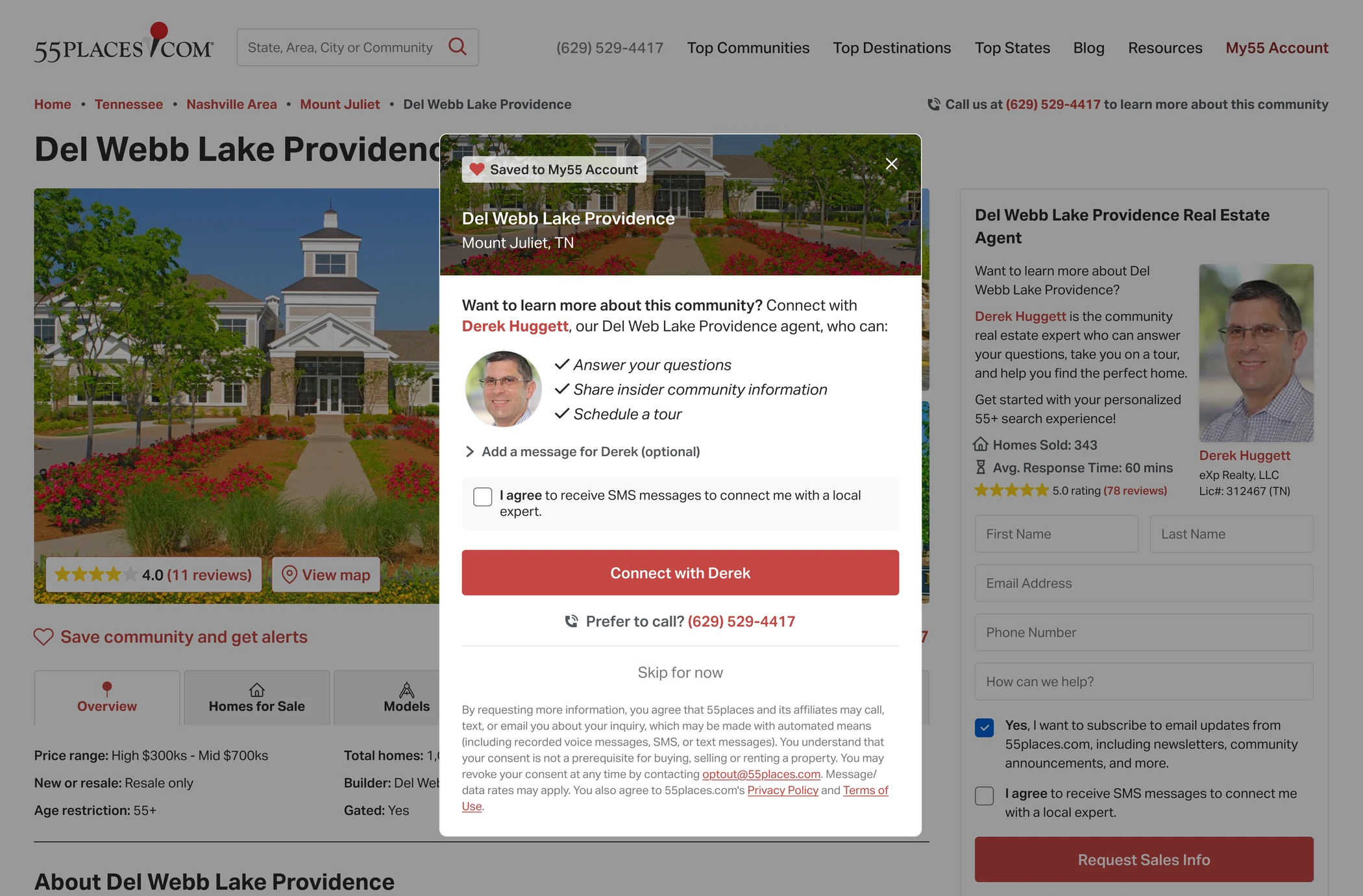
The prompt appears over the community the user just saved — reusing account data, asking only for what’s missing, and always offering a call or a way to skip
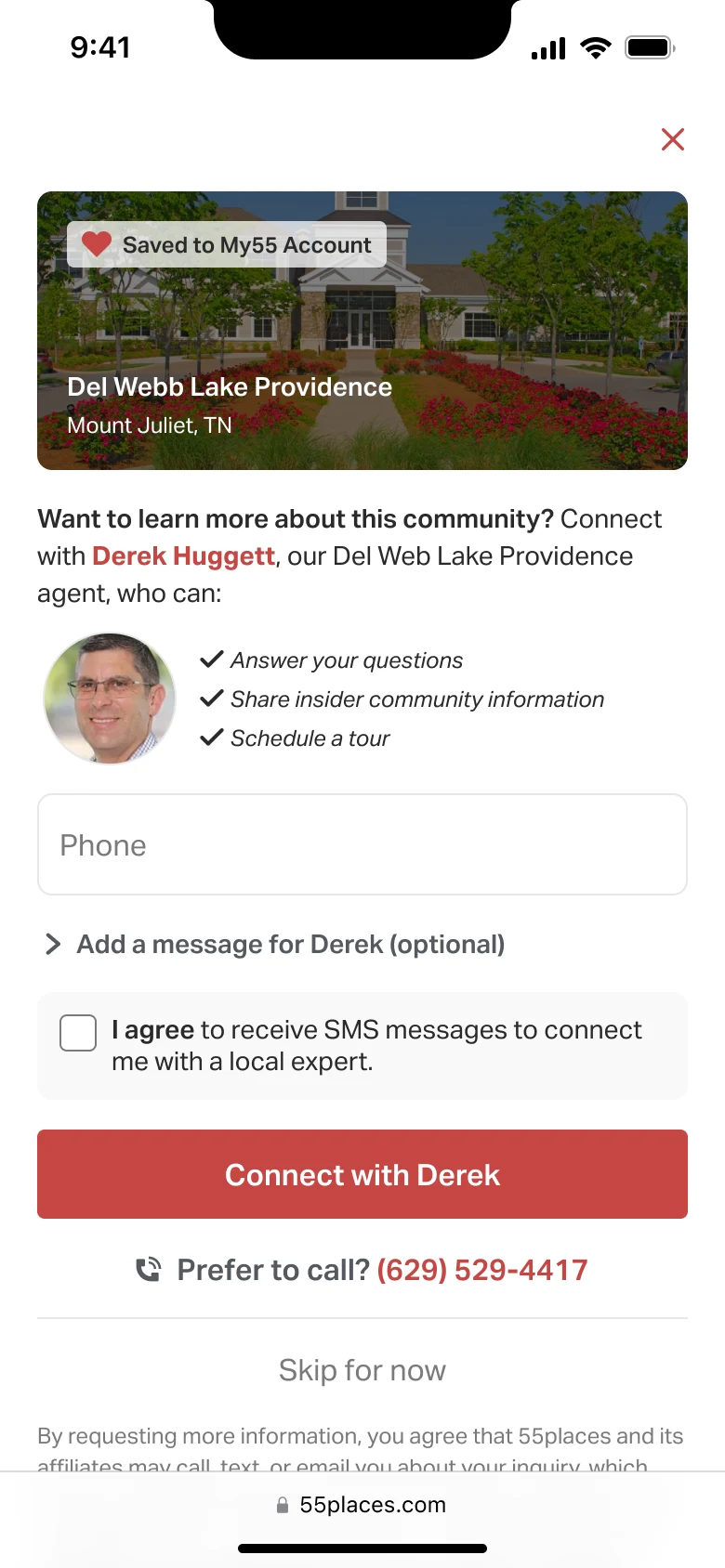
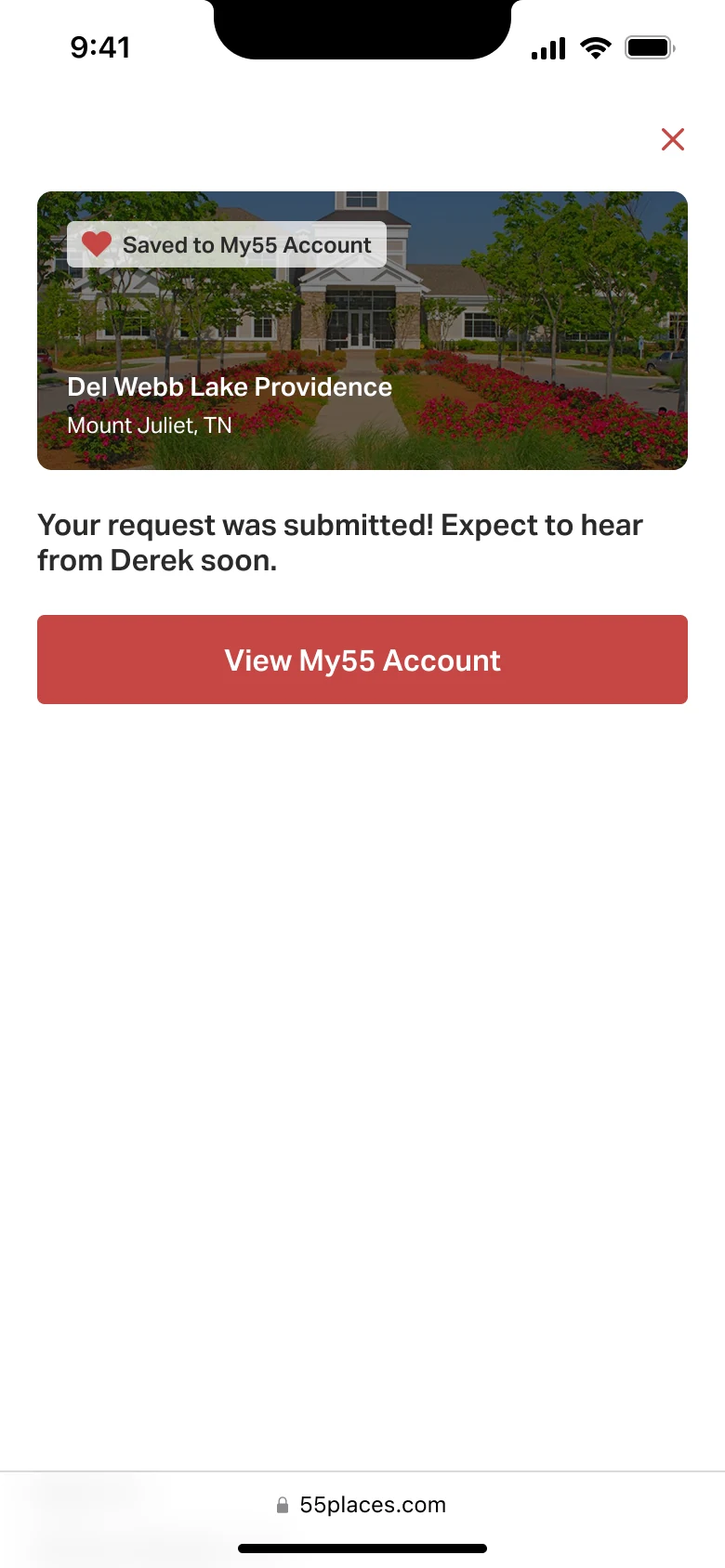
Mobile — the step shows only the fields the account is missing, then confirms the request and routes back to My55
The work wasn’t the modal — it was the matrix behind it. The same component had to resolve correctly across what was saved, what the account already knew, and whether an agent existed to route to. A clean page can simplify the story visually while still showing that logic was covered.
| State / edge case | Design response |
|---|---|
| Community save | Overlay uses community name + city/state; routes to Saved Communities |
| Property save | Overlay uses home address + community; routes to Saved Homes |
| Floor-plan save | Overlay uses plan + community name; routes to My Content |
| Phone already on file | Phone field hidden in step two |
| Name or phone missing (SSO / returning users) | Show only the missing required fields |
| No agent assigned | Generic local-expert language and CTA; no named agent |
| Short mobile viewport | Scrollable modal keeps CTA, disclaimer, and skip reachable |
| User not ready to talk | Skip for now preserves the save |
A slice of the state matrix — save type × account data × agent availability
04 Outcome
What the test showed. The variation went live on March 24, 2026 as a 50/50 A/B test across 483,000 users, scoped to the three save actions. By the April readout the new path had produced real volume through a form that hadn’t existed before, while sitewide conversion sat flat against control — no lift, and no cost. On April 21 the team rolled it out to 100% of traffic on exactly that basis: the same outcome, reached with less friction.
Measured on its own. Attribution was built into the pattern from day one — new form IDs and data-layer events — so the progressive path could be measured on its own:
| Measure | First-month result |
|---|---|
| Progressive-form submissions | 74 (Mar 24 – Apr 23) |
| Directly attributed SQLs | 61 (goal: 71) |
| Sitewide SQL rate, variant vs. control | 0.69% vs. 0.69% — flat |
| Lead success rate, variant vs. control | 0.72% vs. 0.71% — directional, not significant |
| Day-0 MQL → SQL, test vs. prior | 5.58% vs. 4.33% — not statistically significant |
| SQL accounts after 100% rollout | 136 |
| Blog CTA SQLs, across 31 articles | 34 |
Method: directly attributed SQLs from progressive-form IDs over the March 24 – April 23, 2026 test window, plus a post-rollout leadership readout. Day-0 conversion movement was directional and not statistically significant; the rollout decision rested on attributed volume and a lower-friction path, not a proven sitewide lift.
Why flat is the interesting result. The likeliest explanation is that the flow moved conversions rather than manufacturing them. Day-0 MQL → SQL rose over the test period while the same action after day one — the email-driven path, notably the My55 account welcome — fell. Users who would have converted a day later through an email appear to have converted immediately instead. That is a smaller claim than a lift, and a more useful one: the value was in shortening the path, not widening it.
What it unlocked. The real output wasn’t 61 SQLs — it was a repeatable way to convert intent without adding pressure. Once the pattern existed, it spread: a blog CTA on content pages, a sticky agent CTA for scrolled desktop sessions, a Request a Tour flow with date-and-time selection, Google SSO auto-login to cut authentication friction, and auto-account-creation extended to seller leads, newsletter signups, and landing pages. A single save-to-SQL modal became the platform’s default answer for turning a high-intent moment into an owned relationship.